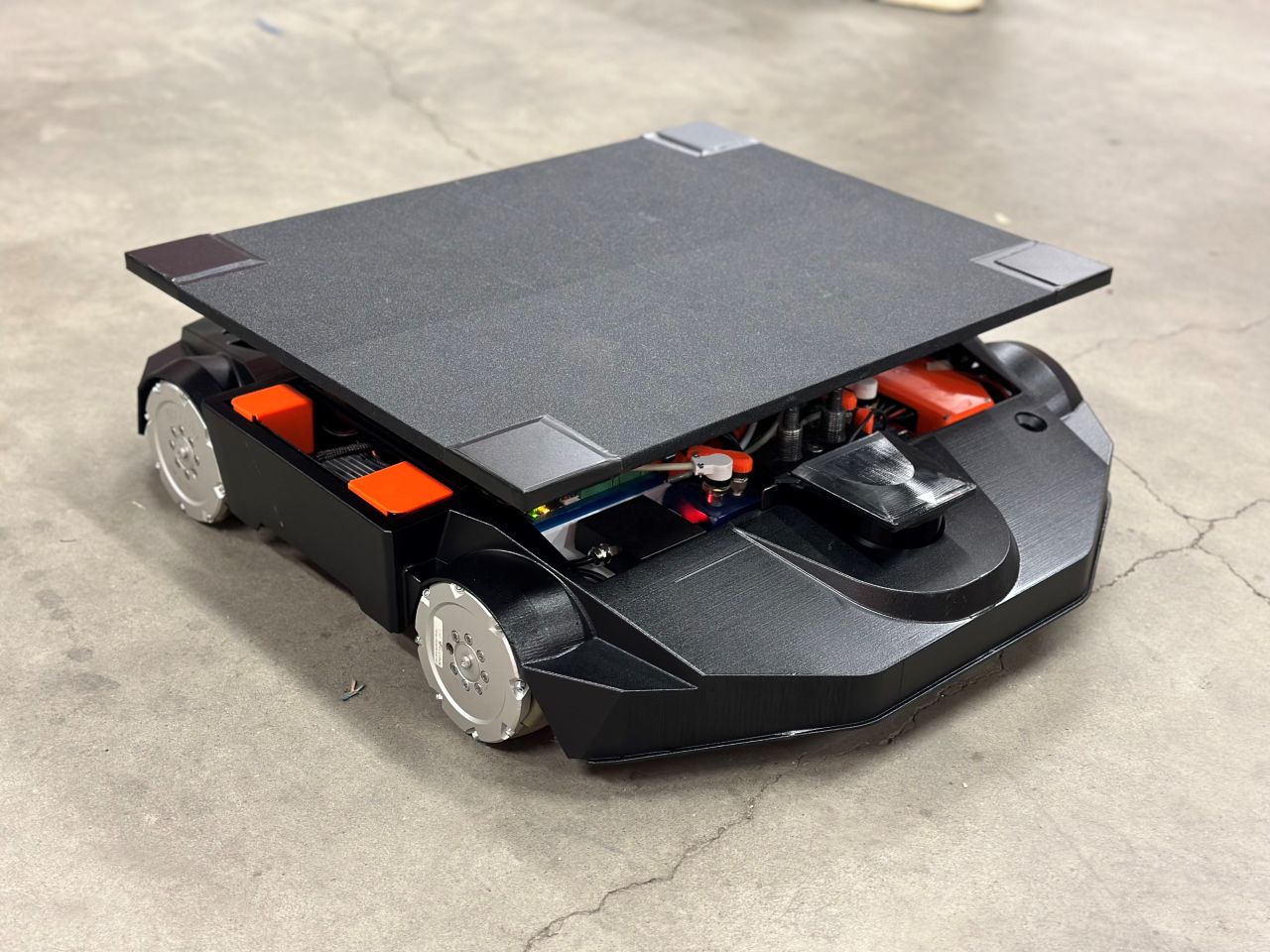
Simulation as a foundation for reliable robotic systems.
Digital twins allow us to develop, test, and refine robotic systems long before they are deployed in the real world. At Dyno Robotics, we use digital twins as a core tool for building reliable autonomy, reducing risk, and accelerating development.
A digital twin is a virtual representation of a physical system, a robot, an environment, or both. By recreating real-world conditions in simulation, we can explore behaviors, validate assumptions, and iterate quickly without putting hardware at risk.
Simulation First, Reality Ready
We use digital twins to prototype navigation, perception, and control systems early in the development process. This allows us to test different sensors, placements, and algorithms, and understand how a robot will behave under varying conditions such as uneven terrain, obstacles, or limited visibility.
Working in simulation makes it possible to move fast while staying precise. Once a system performs well in the digital twin, it can be transferred to the physical robot with confidence.
Bridging Software and Hardware
Digital twins help us close the gap between software development and real-world deployment. By using the same software stack in simulation and on the robot, we ensure consistency between testing and operation. This approach makes debugging easier, improves system robustness, and shortens the path from prototype to deployment.
We often combine digital twins with tools such as ROS 2, SLAM, LiDAR, cameras, and custom sensor setups to create realistic testing environments tailored to each project.
Safer Testing and Better Decisions
Testing autonomous systems directly in the real world can be costly, time-consuming, and risky. Digital twins allow us to safely explore edge cases, failure modes, and rare scenarios that would be difficult or unsafe to reproduce physically. This leads to better informed design decisions and more reliable systems.
Built for Real Environments
Whether it’s an agricultural field, an urban neighborhood, or an indoor workspace, we design digital twins that reflect the environments our robots will actually operate in. This focus on realism helps ensure that what works in simulation also works in practice.
By using digital twins throughout our projects, we create robotic systems that are not only technically advanced, but also robust, predictable, and ready for real-world use.